

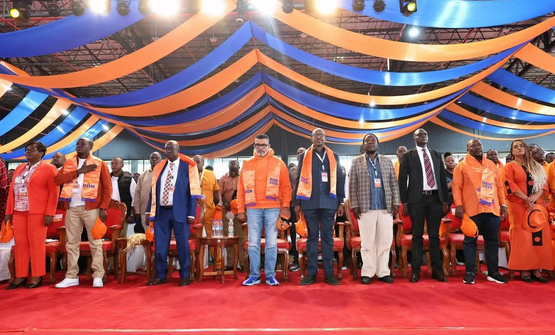
The greatest threat facing the Orange Democratic Movement (ODM) today is not whether it secures a deputy president slot in future political arrangements. It is whether it can defend its political territories from steady encroachment by the United Democratic Alliance (UDA). In the post-Raila Odinga era, ODM’s survival hinges less on elite bargaining at the top and more on strategic consolidation at the base. And that consolidation requires one critical tool: zoning.
Political parties survive by maintaining representation, cohesion, and territorial control. ODM’s historic strength has been its ability to dominate key regions, Nyanza, Western, Coast, and parts of Nairobi, while projecting a national identity anchored in reform and social justice. However, that dominance is now under direct pressure. UDA is no longer a peripheral competitor; it is making deliberate, calculated inroads into ODM strongholds. This is not just electoral competition; it is territorial infiltration.
Every ward, constituency, and county ODM loses weakens its organisational backbone. Parliamentary numbers are built from these local battles. If ODM begins to lose ground in its core regions, its national relevance will erode rapidly. The lesson from Kenyan politics is clear: parties do not collapse overnight; they decline gradually, seat by seat, region by region.
This is precisely why zoning matters more than ever.
Zoning, often misunderstood as mere political convenience, is in reality a defensive strategy. It allows a party to manage internal competition, reduce fragmentation, and present a united front against external challengers. In ODM’s current situation, zoning can serve as a protective mechanism against UDA’s expansion. By ensuring that different regions and communities within ODM feel represented and valued, zoning reduces the risk of internal splits that UDA can exploit.
Without zoning, ODM risks turning inward at the very moment it should be defending outward. Leadership contests, nominations, and internal rivalries could fragment the party into competing factions. And in politics, divided houses are easily conquered. UDA’s strategy will thrive on such divisions in the 2027 elections, offering alternative platforms to disgruntled leaders and voters who feel excluded or marginalised within ODM.
History provides a sobering warning. Kenya African National Union (KANU) did not lose power simply because of one election. It lost because it failed to manage internal cohesion and adapt to a competitive multiparty environment. As internal divisions grew and public trust declined, rival coalitions capitalised on its weaknesses. By the time of the 2002 election, KANU’s defeat was not sudden; it was the culmination of years of organisational decay.
ODM must avoid walking the same path.
Zoning, if properly implemented, can stabilise ODM’s internal environment. It can ensure that leadership positions, nominations, and opportunities are distributed in a way that reflects the party’s diverse support base. This is not about abandoning meritocracy, as it is about creating a framework where merit operates within a structure of inclusion. When regions feel secure within the party, they are less likely to defect. When leaders feel recognised, they are less likely to rebel.
More importantly, zoning strengthens ODM’s electoral machinery. A united party can mobilise voters more effectively, coordinate campaigns across regions, and maximise its parliamentary seats. And in Kenyan politics, numbers matter. Parliament is where power is exercised, alliances are negotiated, and political survival is determined. A party that loses its parliamentary base loses its voice, regardless of whether it holds executive positions.
This brings us back to the central argument: the deputy president position is a distraction.
Executive power without a strong parliamentary and grassroots foundation is fragile. ODM could theoretically secure a deputy president slot through coalition politics, but without a solid base of MPs and local leaders, that position would lack real influence. It would be symbolic rather than substantive. Meanwhile, UDA would continue to expand into ODM territories, gradually weakening the party from below.
Zoning, by contrast, addresses the root of the problem. It helps ODM protect its strongholds, maintain unity, and rebuild its organisational strength in the absence of Raila’s unifying presence. It transforms internal competition from a destructive force into a managed process. And it signals to voters that ODM remains a party of inclusion, not exclusion.
Of course, zoning is not without risks. It can limit open competition and, if misused, entrench elite control. But the absence of zoning in a fragmented party can be even more dangerous. The challenge for ODM is to strike a balance—using zoning to stabilise the party while ensuring transparency and fairness in its application.
ODM’s survival will not be decided in boardrooms or coalition negotiations. It will be decided in constituencies, wards, and communities where political loyalty is built and sustained. UDA understands this, and is acting accordingly.
ODM must respond with equal strategic clarity, insisting on zoning at all costs.
In politics, survival belongs to those who control their ground. For ODM, zoning is not just a tactic, it is a shield. And without that shield, even the promise of high office will not save it from slow political erosion.
Join the Discussion
Share your thoughts and engage with the community
Leave a Comment
Comments
No comments yet. Be the first to share your thoughts!